

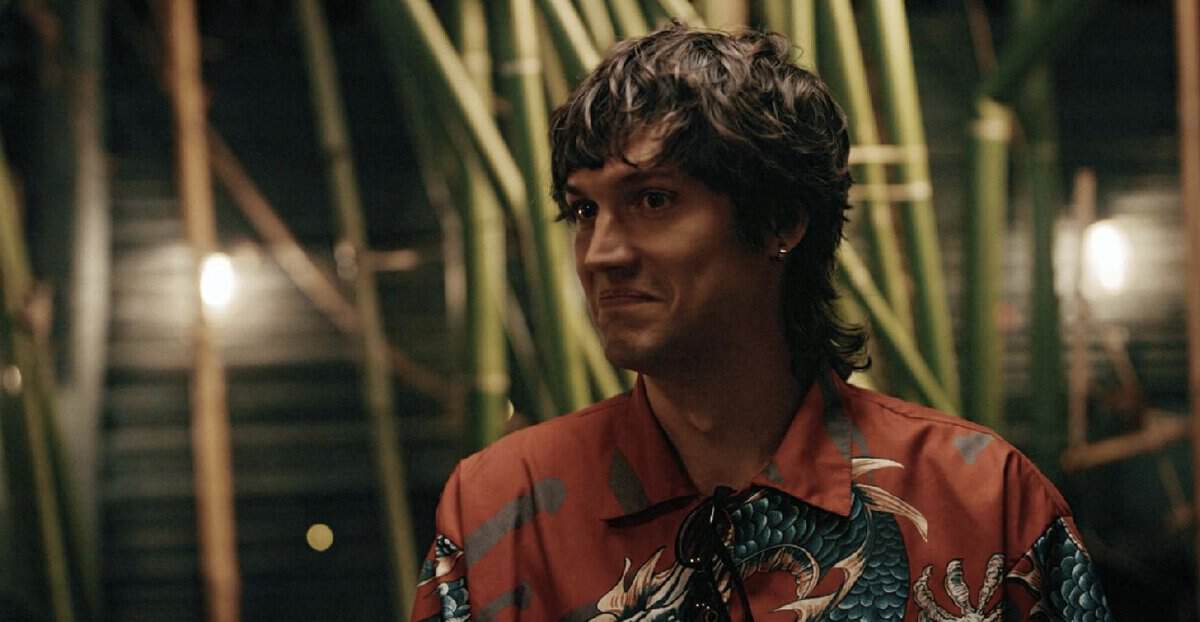
Juan Teisaire first reached international audiences as Willy in Nickelodeon and Telefe’s Kally’s Mashup. Today, the Argentine actor is preparing for the arrival of two new films: Junkie Diaries, an upcoming feature directed by Dave Morrissey Jr. in which he plays the lead, and Governors Island, directed by Rebecca Eskreis, which is continuing its festival run after premiering at the Academy Award-qualifying Indy Shorts International Film Festival.
We spoke with Teisaire about his approach to training, making the transition from theater to television, performing in two languages, and the work audiences rarely see behind a natural performance.
You had already begun acting professionally in Argentina. What led you to study in New York?
I always felt like something was missing. I don’t say that to criticize the acting industry in Argentina, because there are incredible actors and teachers there. But after studying in several different classes, I still hadn’t found an approach that matched what I expected acting training to be.
I had been reading Stanislavski, Adler, Meisner, and Strasberg, and Strasberg’s work resonated with me the most. I went to New York to study Method acting at the Lee Strasberg Theatre and Film Institute. About four months into the program, I realized that I wanted to expand my career into the American industry as well.
One of your earliest major television experiences was Kally’s Mashup. What was it like entering a production of that scale?
It was a crazy way to jump into professional television. It felt like going from zero to one hundred.
We were working with multiple cameras shooting simultaneously, so I quickly learned how important blocking is. I came from a theater background, and I began recognizing the differences between acting freely onstage and finding that same freedom within the technical requirements of a camera.
What fascinated me most was seeing how all the separate pieces eventually became an episode. You can film scenes multiple times and completely out of order, and then sit down to watch the finished work and see how everything fits together. The actors are only one part of it. Sound, editing, continuity, camera—everyone contributes a piece that makes the entire puzzle work.
The award-winning Cortado drew from your experience navigating life in another language. Why was that story so personal to you?
It was a story I needed to tell because it was sitting too close to me. At that moment, I was an Argentine trying to find my place in an English-speaking environment, and I wanted the film to reflect what I was actually experiencing.
I didn’t overthink it. I wanted to play a character who existed in that specific place between two languages and two versions of himself. Sometimes a story feels distant and you have to search for your connection to it. With Cortado, the connection was already there. I was living it.
What makes you say yes to a character?
As long as there is a real person in there, I’m interested. I look for a story, an arc, a personality, and a particular rhythm.
The genre can change completely. What matters is whether the character has an internal life and whether something genuinely happens to them. I want to feel that the person existed before the first scene and will continue existing after the story ends.
You have acted extensively in both English and Spanish. Does your work change depending on the language?
It did at first. Acting in English required more conscious effort, and I was sometimes aware of the language while I was performing.
I also think I carried—and still carry—a little of my Argentine or Latino personality into English-language roles. That can be an advantage because it leads me toward choices that another actor might not make. The rhythm can be different, the humor can be different, and even the way a character expresses affection or anger can come from another cultural instinct.
Now the two sides are slowly merging. I’ve reached a point where the language matters less than the character. I’m not thinking, “How would I act this in English?” I’m thinking about who this person is.
What do people misunderstand about acting?
How difficult it is.
If someone watches a musician play a complicated guitar solo, they immediately understand that it took years of practice. They know they couldn’t simply pick up the instrument and do the same thing. But when people watch a very good actor, the performance can look so natural that they only see a real person. Because they are also real people, they think, “I could do that.”
That reaction is almost a compliment to good acting, but it can also hide the craft behind it. Making something look effortless usually takes an enormous amount of preparation, technique, and repetition.
What part of your work makes you proudest?
Being able to bring something of Argentina into roles that may not have been written specifically for an Argentine actor.
I don’t mean adding a superficial trait or simply performing the character with an accent. It’s more personal than that. I can bring a particular rhythm, sensitivity, humor, or way of seeing the world into an English-language role. Those qualities are part of me, so they naturally become part of the work.
I’m proud that the Argentine and American sides of my career no longer feel separate. They have become part of the same actor.


 Preferred Source
 Google Discover
 Google News